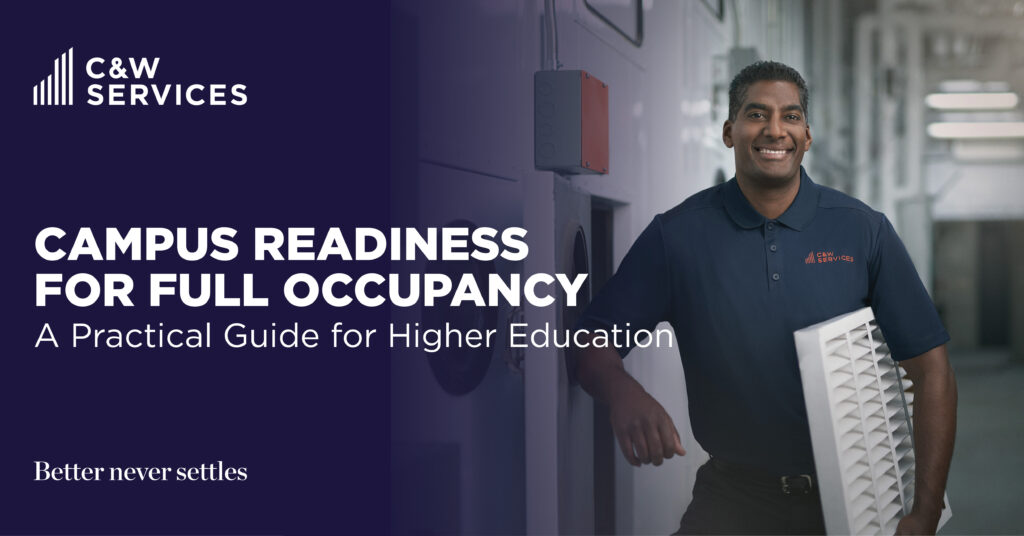
Higher education operates on a different rhythm than most industries. While many organizations slow down during the summer months, campuses enter one of their most important operational windows. From late May through mid-August, a campus that spends most of the year at full load quiets down enough for facilities teams to do the work a live campus won’t allow: deep systems checks, fume hood certifications, floor-to-ceiling cleaning, and the mechanical commissioning that keeps residence halls, classrooms, and research buildings running once students return.
Miss it, and the work either doesn’t get done or gets done around people, which makes it slower, more disruptive, and often less effective.
The instinct is to treat summer as a collection of independent projects: cleaning here, HVAC there, lab work handled by the science departments, custodial by a separate team, deferred maintenance queued in yet another system. Each function knows its role. What often gets lost is the coordination that turns those individual efforts into a single readiness story: a campus that arrives at move-in day with documented, verified operations across labs, common spaces, base building systems, and the CMMS records that tie it all together.
That’s the shift worth making. Campus readiness isn’t a checklist of separate tasks that happen to share a season. It’s an integrated program in which lab validation, enhanced cleaning, base-building commissioning, and CMMS readiness are sequenced. When the first students walk into the first classroom in August, every space they’ll use has been prepared, tested, and documented against the demands about to be placed on it.
Validate Labs and Controlled Environments for the Academic Year
Labs are the part of campus that summer suits best. When class populations are down, and research schedules are lighter, there’s finally room to open a hood, take a bench offline, cross-check a controls sequence, or swab a surface without pulling a class off a syllabus or a PI off a project. That window closes fast in September. What gets validated now is what a lab can be trusted to hold through the academic year.
The point of the exercise isn’t just to clean and calibrate; it’s to reach late August with each lab carrying a documented readiness record. Not a general sense that things look fine. A defensible answer to three specific questions: Do we know what’s in this space and what condition it’s in? Are the environmental systems holding the conditions the science depends on? And can we prove the surfaces meet the standard we’ve committed to?
Answering those questions honestly takes three coordinated workstreams.
Asset accuracy first. Labs are dense with equipment, and lab inventories drift faster than most other campus records. Fume hoods get relocated. Biosafety cabinets get swapped in and out. Freezers and incubators get retired or replaced without the CMMS catching up. Asset verification confirms the presence and status of listed assets so the CMMS reflects the true state of physical equipment, creating a reliable baseline for maintenance planning and asset management.
Environmental systems next. A lab is only as reliable as the air it’s holding. Temperature, humidity, pressurization, air changes per hour, and hood face velocity are the invisible conditions that determine whether experiments hold their integrity and whether the space stays safe to occupy. A well-tuned building automation system helps hold those conditions steady while managing energy use across the building. Summer provides the best opportunity to tune those systems before laboratories return to full occupancy, giving facilities teams the visibility to catch drift before the semester exposes it.
Finally, the surfaces themselves. With assets accounted for and conditions holding, the last layer is confirming that the physical spaces meet the standard the campus stands behind. For controlled environments, visual inspection isn’t enough. High-level disinfection protocols, ATP swab testing, and quality assurance inspections validate results rather than assume them.
Done together, those three workstreams transform summer maintenance into documented operational readiness: labs that begin the semester with equipment accounted for, environmental conditions confirmed, and surfaces validated.
Complete Enhanced Cleaning During the Summer Window
Cleaning is the part of campus readiness that occupants notice first. A student walks into their room, a parent walks into a residence hall lobby, a faculty member walks into a lab on the first day of classes. And the impression is set in seconds. Whether the space feels ready isn’t only a matter of aesthetics. It reflects whether the work behind that first impression was thorough, staged well, and verified.
Summer is what makes that thoroughness possible. During the year, cleaning has to work around class schedules, residence hall routines, research activities, and campus events. In the summer, buildings and rooms can be turned over systematically, giving facilities teams the room to complete the kind of deep reset campuses need before full occupancy returns.
The most effective approach is to stage the work, space by space. Residence halls, classrooms, common areas, and labs each need a defined window for cleaning, validation, and closeout before the next space begins. Enhanced cleaning designed for controlled environments goes beyond standard sanitation, using high-level disinfection protocols, touchpoint sanitation, ATP swab testing, and quality assurance inspections to verify that spaces meet established standards before occupants return.
Cleaning should also be coordinated with broader building readiness efforts. HVAC readiness and system optimization should be planned alongside enhanced cleaning so building automation systems can be tuned, monitored, and optimized before full occupancy returns. Aligning these efforts supports airflow performance, reduces duplicate work, and helps teams avoid correcting in September what could have been handled once, in sequence, over the summer.
Done this way, cleaning stops being a task that gets checked off and starts being a standard the campus can point to. Validation-backed cleaning delivers clean, verified spaces that support occupant well-being and set the tone for a strong move-in experience.
Commission Systems and Align the CMMS for the Academic Year
Labs validated. Spaces prepared. The last piece of readiness is the base building itself, and the records that govern how it will be maintained through the year.
Commissioning confirms that building systems are ready to operate as intended before full occupancy returns. A boiler that fired last winter isn’t guaranteed to hold setpoint under a fully occupied residence hall in October. A chiller that carried a light summer load isn’t the same asset as one that handles peak load. Building automation systems can then be tuned and continuously monitored to optimize performance, maintain occupant comfort, and identify drift before it affects the academic year.
Behind the commissioning is the record layer, and this is where many campuses quietly fall short. A commissioned building is only as maintainable as the CMMS behind it. Asset verification corrects the drift that accumulates over an academic year. Equipment gets relocated. Assets get replaced without records updating. Preventive maintenance schedules become disconnected from the equipment actually in service. Fixing that baseline before the semester begins helps ensure work orders route accurately, preventive maintenance aligns with current assets, and maintenance planning becomes reliable rather than aspirational.
Verified asset data also drives the schedule. Preventive maintenance aligned to the academic calendar—heavier around move-in, exam periods, and breaks; lighter when buildings are quiet—puts effort where the building actually needs it. It also helps facilities leaders allocate crews, budget, and vendor time against a shared source of truth rather than estimates.
That coordination is what separates a summer of commissioning work that holds through May from one that quietly unravels by October. Building systems supported by accurate asset records create facilities that operate predictably throughout the academic year, not just on move-in day.
Prepare Your Campus with Confidence
Successful campus readiness isn’t measured by how much work gets done over the summer. It’s measured by how few surprises remain when students, faculty, and researchers return.
Campus readiness is strongest when lab validation, enhanced cleaning, building system optimization, and asset management are treated as one coordinated program rather than four separate projects. C&W Services helps higher education institutions bring those efforts together, creating documented, verified operations across labs, residence halls, classrooms, common spaces, building systems, and CMMS records.
Contact C&W Services to develop a campus readiness strategy that carries beyond move-in and through the full academic year.