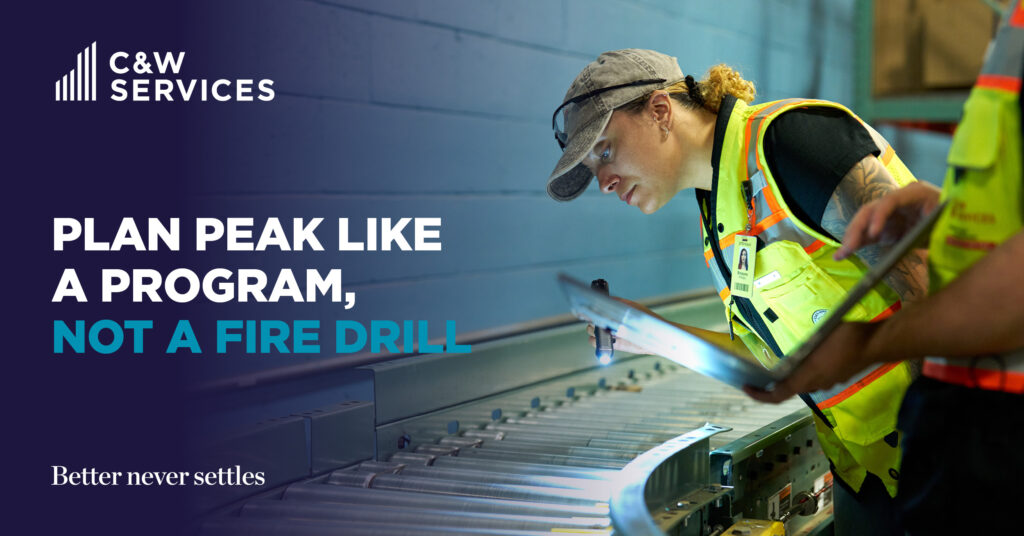
Your facility either accelerates production or constrains it.
During peak windows, every minute of dwell time, waiting, rework, or unplanned downtime is a tax on throughput. Those minutes compound fast. The fix is alignment across the facility environment, material flow, and the frontline, so work moves without friction.
Peak doesn’t reward effort alone. It rewards alignment.
Stabilize the Environment Before the Rush
Peak season doesn’t create facility problems—it exposes them. The HVAC system that was slightly off-spec in September becomes the reason a temperature-sensitive line slows in November. The building automation alert that sat unacknowledged during a normal shift becomes a two-hour stoppage during the highest-volume week of the year. By the time the floor feels the impact, the window to fix it cleanly has already closed.
24/7 Building Automation System (BAS) connectivity changes that equation. When temperature, humidity, and environmental set points are monitored continuously from a centralized control point, deviations surface before they affect line speed. Engineers manage the system throughout design, installation, and maintenance, so real-time oversight isn’t just a dashboard. It’s a staffed capability backed by accountability. The people responsible for your facility aren’t reacting to conditions the floor already knows about. They’re ahead of them.
The second layer is converting visibility into response. BAS alerts are only useful if they automatically route to standard responses and on-call resources. During a surge, the difference between a contained issue and an escalating one is often measured by how long it takes to get the right person moving. When alert routing is built into the system and tested before peak, that response time compresses. The fix happens between shifts, not during them.
The third piece is calibration. Controls and schedules tuned for normal operating conditions aren’t optimized for extended shifts, higher occupancy, and increased equipment load. Pre-peak calibration protects throughput while lowering energy cost. Those two outcomes usually sit in tension, but don’t have to. Advanced diagnostics go further, identifying failure patterns before they become unplanned downtime and extending equipment life in the process. A facility operating at the right setpoints under peak load isn’t just more productive. It costs less to operate and less to maintain over time.
The bottom line: round-the-clock visibility keeps the environment from becoming the constraint nobody planned for.
Remove Mechanical Bottlenecks in the Flow
In a distribution or manufacturing environment running at peak rate, the conveyor system isn’t infrastructure—it’s the production line. Every jam, mis-sort, or speed mismatch between zones is a throughput event. Cartons back up, pick-and-pack slows, ship windows tighten, and the labor that was supposed to be moving product is now clearing jams and reworking misrouted orders. The problem compounds faster than it gets fixed.
Precision maintenance of conveyors and sorting equipment—not reactive maintenance—prevents that cascade. The distinction matters. Reactive maintenance responds to failures after the floor has already felt them. Precision maintenance focuses on the wear patterns, load profiles, and failure modes most likely to disrupt flow under sustained peak conditions. Addressing those conditions on a disciplined schedule keeps them from becoming floor-level problems during the shifts that matter most.
The staging step is what makes precision maintenance executable at peak. Quick-change spares positioned at the right points in the system, combined with pre-peak inspection intervals, mean corrective work gets completed between shifts rather than during them. When a technician can swap a component in minutes instead of waiting on a part that’s hours out, the difference shows up immediately in uptime. The preparation happens before the rush. The floor never feels it.
The framing that ties this together is treating conveyance as a takt-critical asset family. Takt time is the rate at which finished product must be produced to meet demand, and any asset that sits on the critical path of that rate deserves maintenance priority and focused repair resources to match it. When conveyors and sortation equipment are managed to that standard, flow stabilizes, rework drops, and operating costs fall. Throughput rises without adding headcount to compensate for mechanical friction.
The bottom line: when the backbone of material movement runs smoothly, throughput rises without adding labor.
Orchestrate Crews in Real Time
A stable environment and healthy conveyors create the conditions for throughput. Crews are what actually deliver it. And during peak, the difference between a floor that recovers quickly from disruption and one that compounds it almost always comes down to communication: how fast a lead gets the right information, how clearly a technician receives a line call, how quickly a supervisor can coordinate a response across a facility that may span hundreds of thousands of square feet.
Radio dead zones, language barriers, delayed escalations, and slow handoffs aren’t dramatic failures. They’re the low-grade friction that accumulates across every shift and quietly taxes throughput all peak long.
With reliable coverage indoors and out, Relay connects supervisors, responders, and technicians across any device with instant communication, real-time location tracking, and emergency alert capability. When a line goes down or a changeover needs coordination, the right people are reached immediately. Real-time task management assigns work to the nearest available technician, cutting travel time and compressing response from minutes to seconds. Escalations don’t get lost. Line calls don’t wait. And because team members and key equipment are visible on the same platform, leaders know where resources are in real time, instead of where they were ten minutes ago.
Language translation is the layer that most facilities underinvest in. Peak workforces are diverse by design. The labor pools that enable surge capacity often speak a dozen languages in a single shift. Built-in translation closes that gap during changeovers and recoveries—the two moments when clear, fast communication between mixed teams is most critical and most likely to break down. When everyone on the floor receives the same instruction with the same clarity, execution tightens and recovery time shrinks.
The data layer is what pays forward. Communication platforms generate insight into response times, task durations, and movement patterns that can be analyzed after peak to identify where friction actually occurred. Over time, those insights reshape staffing models, standard work, and floor coverage. The operation doesn’t just recover from one peak—it gets structurally faster for the next one.
The bottom line: coordinated crews move faster and safer, which removes the people-process friction that peak exposes every time.
Take the Fire Drill Off the Table
Peak performance isn’t built during the rush; it’s built before it starts. C&W Services works with manufacturing and logistics teams to align facility systems, mechanical reliability, and frontline execution into a single operation that performs at peak volume and under the highest scrutiny.
Connect with C&W Services to build a peak program that holds under pressure.